


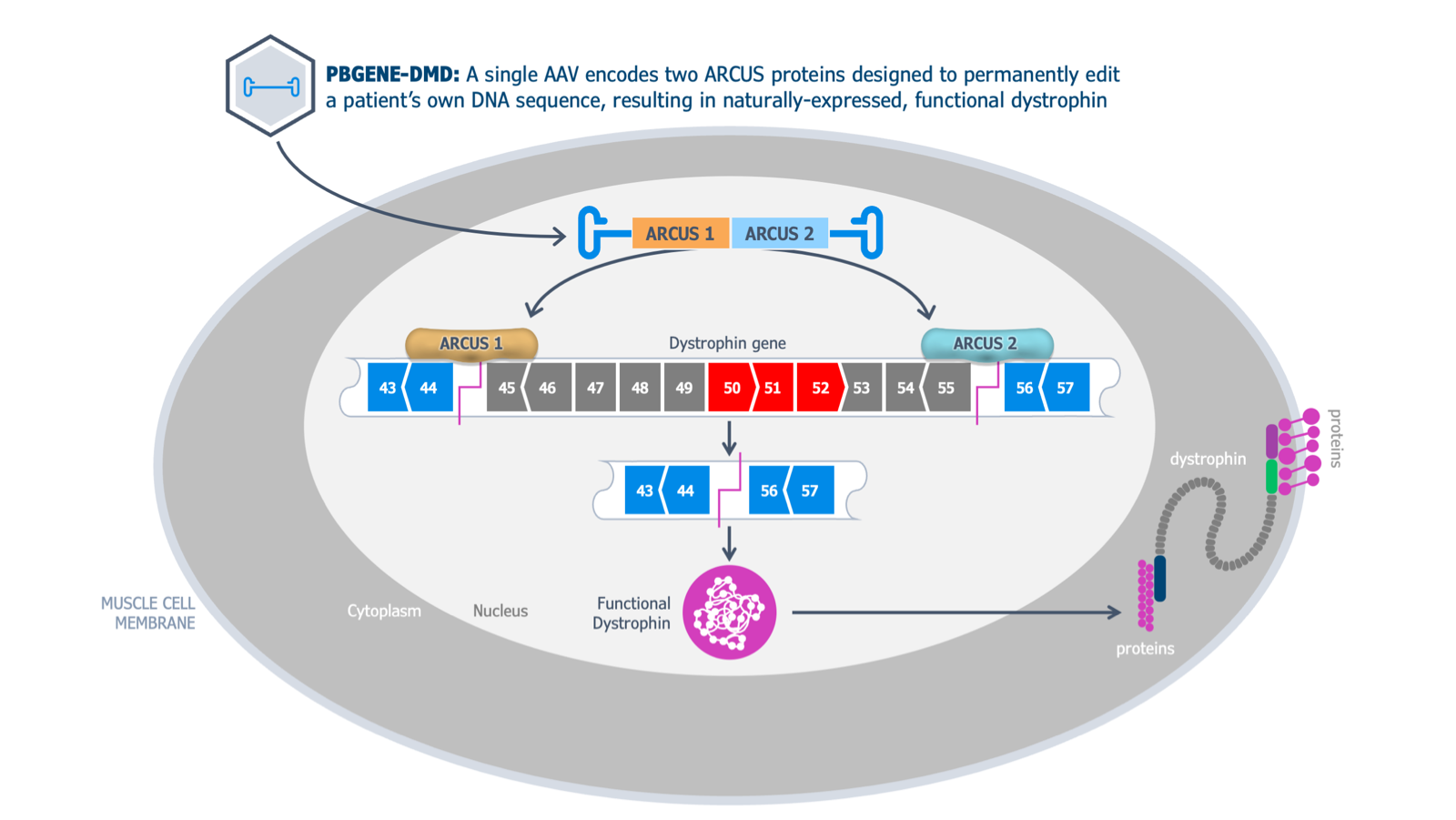
Precision BioSciences has developed PBGENE-DMD, an ARCUS gene editor designed to excise the ‘mutation hot spot’ region spanning exons 45 through 55 of the dystrophin gene with the goal of permanently and safely restoring muscle function.

FUNCTION-DMD is a phase I/II trial for ambulatory boys aged 2 to 7 with confirmed mutation(s) within exons 45 through 55.


To connect with one of our study sites, please contact our Patient Advocacy Team at: patientadvocacy@precisionbiosciences.com
DMD Currently Lacks a Curative Treatment
DMD is a genetic disorder resulting in progressive muscle degeneration and early death. It affects skeletal, cardiac, and respiratory muscles, resulting in progressive weakness, loss of ambulation, respiratory insufficiency, and cardiac failure leading to premature death.
Current DMD treatments have limitations, including their inability to provide durable functional improvement for patients.
∼15K
DMD patients in the United States1


∼300-400K
DMD patients globally1

PBGENE-DMD Target Population

∼60% of patients
have mutations in exons 45-55, a critical hot spot where a disrupted reading frame prevents dystrophin expression.2
PBGENE-DMD
PBGENE-DMD is designed to permanently address the root genetic cause of DMD by removing a frequently mutated region of the dystrophin gene in ∼60% of patients, restoring the correct reading frame and enabling natural production of near full-length functional dystrophin.
Learn about DMD and PBGENE-DMD
PBGENE-DMD (Muscle Targeted Excision Program)
Validated preclinical studies demonstrate durable improvements in muscle function, supporting ARCUS gene editing as a potential approach to restore near full-length dystrophin and improve long-term functional outcomes for a broad population of patients living with DMD by addressing the root cause of the disease.
Reasons to Believe in Precision's Approach to DMD
PBGENE-DMD is an investigational therapy that has not been approved by the U.S. Food and Drug Administration (FDA) or any other regulatory authority.
Although the safety and efficacy profiles are currently unknown, it is being assessed in the FUNCTION-DMD clinical trial.
Explore the science behind our approach and the research guiding our work.

- Prevalence and incidence based on CureDuchenne and Orphanet Journal of Rare Diseases.
- Béroud C, et al. Hum Mutat. 2007;28(2):196-202.